The plaques themselves
Tap a plaque to read it full size.
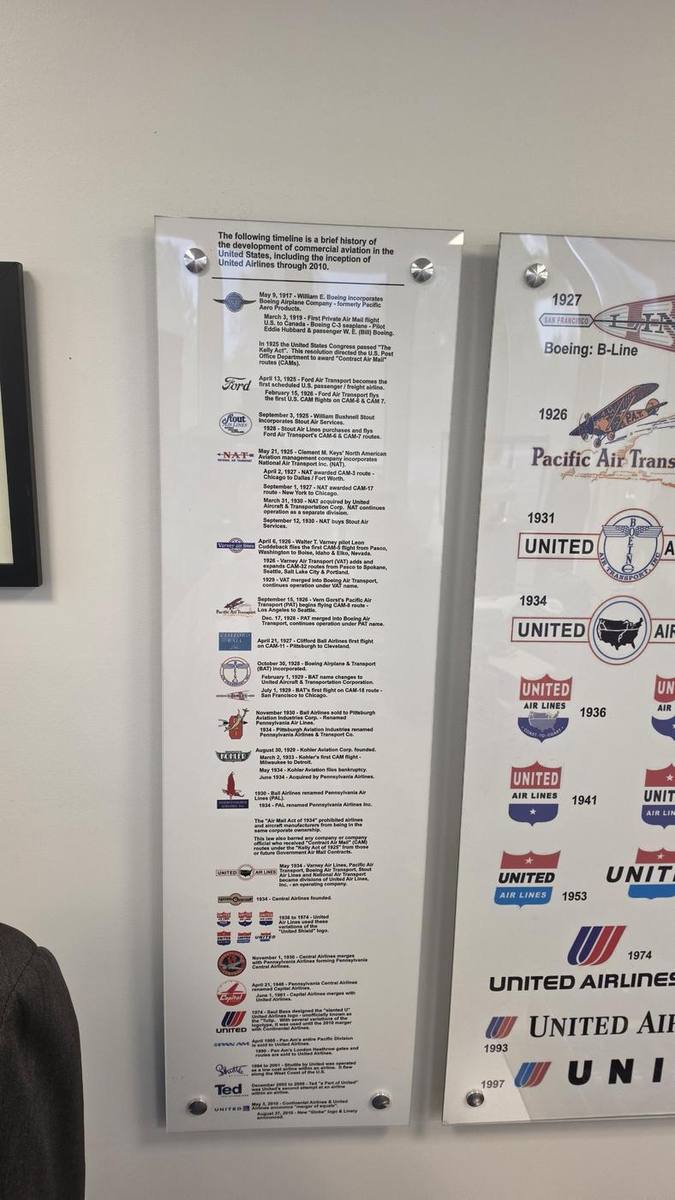
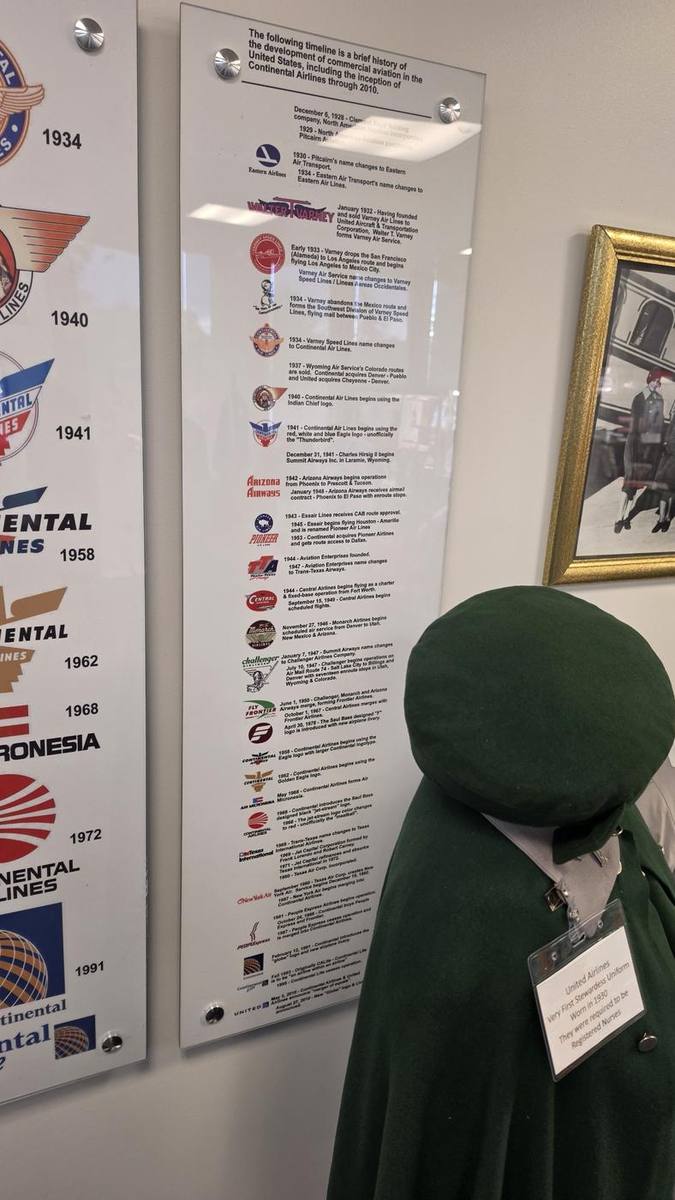
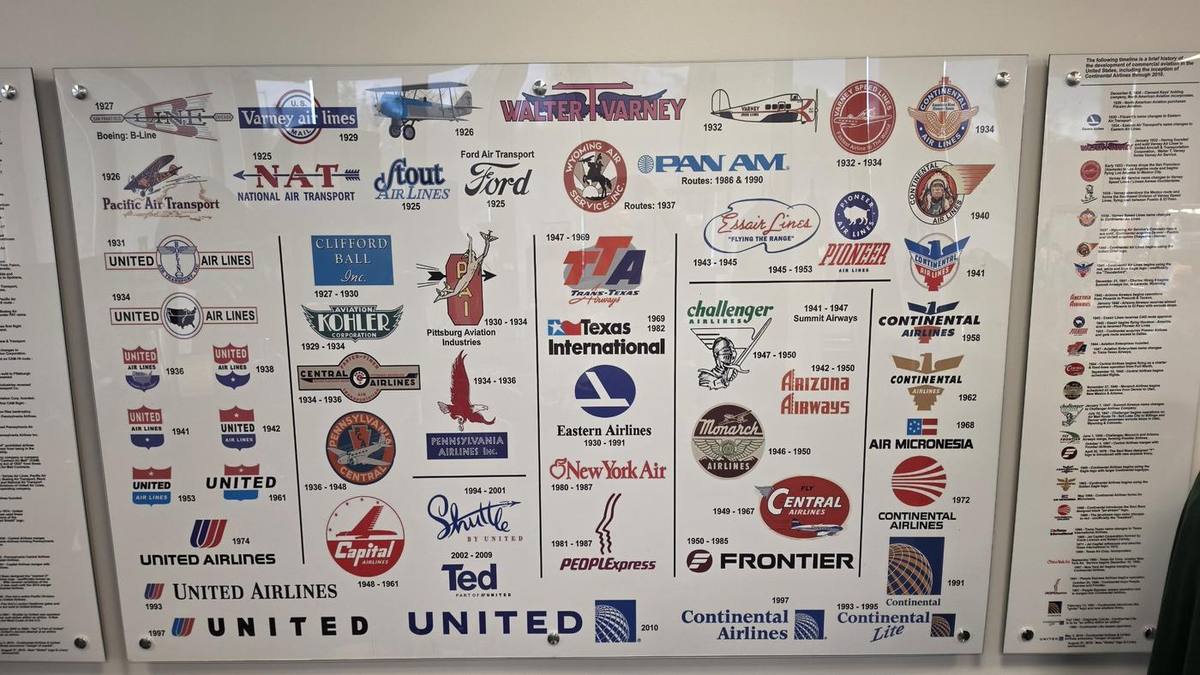
Every dated entry
1917–1929
Pioneers & air mail
William E. Boeing incorporates Boeing Airplane Company, formerly Pacific Aero Products.
United familyFirst private air mail flight, U.S. to Canada: a Boeing C-3 seaplane flown by pilot Eddie Hubbard with passenger W. E. (Bill) Boeing.
United familyCongress passes the Kelly Act, directing the U.S. Post Office Department to award “Contract Air Mail” routes (CAMs).
United familyFord Air Transport becomes the first scheduled U.S. passenger and freight airline.
United familyClement M. Keys’ North American Aviation management company incorporates National Air Transport Inc. (NAT).
United familyWilliam Bushnell Stout incorporates Stout Air Services.
United familyFord Air Transport flies the first U.S. CAM flights, on CAM-6 and CAM-7.
United familyWalter T. Varney’s pilot Leon Cuddeback flies the first CAM-5 flight, from Pasco, Washington to Boise, Idaho and Elko, Nevada.
United familyVarney Air Transport (VAT) adds and expands CAM-32 routes from Pasco to Spokane, Seattle, Salt Lake City and Portland.
United familyVern Gorst’s Pacific Air Transport (PAT) begins flying the CAM-8 route, Los Angeles to Seattle.
United familyNAT is awarded the CAM-3 route, Chicago to Dallas / Fort Worth.
United familyClifford Ball Airlines makes its first flight on CAM-11, Pittsburgh to Cleveland.
United familyNAT is awarded the CAM-17 route, New York to Chicago. (A framed painting in the exhibit marks the “50th Anniversary of Transcontinental Air Service, Sept. 1, 1927–1977.”)
United familyStout Air Lines purchases and flies Ford Air Transport’s CAM-6 and CAM-7 routes.
United familyBoeing Airplane & Transport (BAT) is incorporated.
United familyClement Keys’ holding company, North American Aviation, incorporates.
Continental familyPAT merges into Boeing Air Transport and continues operating under the PAT name.
United familyVAT merges into Boeing Air Transport and continues operating under the VAT name.
United familyNorth American Aviation purchases Pitcairn Aviation.
Continental familyBAT’s name changes to United Aircraft & Transportation Corporation.
United family“Consolidated Schedules and Fares for Air Passengers” of U.S. commercial air transport, framed in the exhibit, lists every passenger line in service on this date.
Exhibit & foundationBAT’s first flight on the CAM-18 route, San Francisco to Chicago.
United familyKohler Aviation Corp. is founded.
United family1930–1939
One airline takes shape
Pitcairn’s name changes to Eastern Air Transport.
Continental familyThe first United stewardess uniform is worn; the first stewardesses were required to be Registered Nurses.
Exhibit & foundationNAT is acquired by United Aircraft & Transportation Corp. and continues as a separate division.
United familyNAT buys Stout Air Services.
United familyBall Airlines is sold to Pittsburgh Aviation Industries Corp. and renamed Pennsylvania Air Lines.
United familyHaving founded and sold Varney Air Lines to United Aircraft & Transportation Corporation, Walter T. Varney forms Varney Air Service.
Continental familyVarney drops the San Francisco (Alameda) to Los Angeles route and begins flying Los Angeles to Mexico City; Varney Air Service becomes Varney Speed Lines / Lineas Aereas Occidentales.
Continental familyKohler’s first CAM flight, Milwaukee to Detroit.
United familyPittsburgh Aviation Industries renames the line Pennsylvania Airlines & Transport Co.; PAL is renamed Pennsylvania Airlines Inc.; Central Airlines is founded.
United familyEastern Air Transport’s name changes to Eastern Air Lines.
Continental familyWilliam A. Patterson serves as United’s president, then is named Chairman of the Board and CEO. (Framed portrait in the exhibit.)
Exhibit & foundationVarney abandons the Mexico route and forms the Southwest Division of Varney Speed Lines, flying mail between Pueblo and El Paso. Later that year, Varney Speed Lines changes its name to Continental Air Lines.
Continental familyKohler Aviation files for bankruptcy. Meanwhile, Varney Air Lines, Pacific Air Transport, Boeing Air Transport, Stout Air Lines and National Air Transport become divisions of United Air Lines, Inc., an operating company.
United familyKohler is acquired by Pennsylvania Airlines. The Air Mail Act of 1934 prohibits airlines and aircraft manufacturers from sharing the same corporate ownership.
United familyUnited Air Lines uses variations of the “United Shield” logo.
United familyCentral Airlines merges with Pennsylvania Airlines, forming Pennsylvania Central Airlines.
United familyWyoming Air Service’s Colorado routes are sold. Continental acquires Denver–Pueblo and United acquires Cheyenne–Denver.
Continental familyContinental’s first Lockheed 12s arrive; Robert F. Six mortgaged his home to make the down payment. (CO Times tribute, Nov–Dec 1986)
Continental family1940–1959
War, radar & the postwar airline
Continental Air Lines begins using the Indian Chief logo.
Continental familyContinental begins using the red, white and blue Eagle logo, unofficially the “Thunderbird.”
Continental familyCharles Hirsig II begins Summit Airways Inc. in Laramie, Wyoming.
Continental familyArizona Airways begins operations from Phoenix to Prescott and Tucson.
Continental familyUnited’s Cheyenne Modification Center updates 5,500 factory-fresh B-17 “Flying Fortress” bombers with the latest equipment and technology.
Exhibit & foundationUnited flies airline operations to Alaska under an Army contract (the United Air Transport Command).
Exhibit & foundationEssair Lines receives CAB route approval.
Continental familyAviation Enterprises is founded. Central Airlines begins flying as a charter and fixed-base operation from Fort Worth.
Continental familyEssair begins flying Houston–Amarillo and is renamed Pioneer Air Lines.
Continental familyMonarch Airlines begins scheduled air service from Denver to Utah, New Mexico and Arizona.
Continental familyAviation Enterprises changes its name to Trans-Texas Airways.
Continental familySummit Airways changes its name to Challenger Airlines Company.
Continental familyInaugural Hawaiian flight: dignitaries greet the arrival of the DC-6 from San Francisco to Honolulu.
Exhibit & foundationChallenger begins operations on Air Mail Route 74, Salt Lake City to Billings and Denver, with seventeen en route stops in Utah, Wyoming and Colorado.
Continental familyArizona Airways receives an airmail contract, Phoenix to El Paso with en route stops.
Continental familyPennsylvania Central Airlines is renamed Capital Airlines.
United familyCentral Airlines begins scheduled flights.
Continental familyChallenger, Monarch and Arizona Airways merge, forming Frontier Airlines.
Continental familyContinental acquires Pioneer Airlines and gets route access to Dallas.
Continental family“Sir Echo” weather-mapping radar, a joint project with Radio Corp. of America (RCA), is tested in a DC-3 test-bed. It leads to airborne weather radar for detecting and avoiding thunderstorms.
Exhibit & foundationFleet-wide installation of the C-band weather radar: another industry-first for United.
Exhibit & foundationContinental begins using the Eagle logo with a larger Continental logotype.
Continental familyContinental is among the first airlines to move to jets, with the delivery of the Boeing 707.
Exhibit & foundation1960–1989
Jets, mergers & new brands
Capital Airlines merges with United Airlines.
United familyContinental begins using the Golden Eagle logo.
Continental familyThe U.S. government awards Continental the Military Airlift Command contract; the company forms Continental Air Services, whose flight operations based in Laos last about a decade.
Exhibit & foundationCentral Airlines merges with Frontier Airlines.
Continental familyContinental introduces the Saul Bass–designed black “jet-stream” logo; the color changes to red, unofficially the “meatball.”
Continental familyContinental forms Air Micronesia.
Continental familyTrans-Texas changes its name to Texas International Airlines. Jet Capital Corporation is formed by Frank Lorenzo and Robert Carney.
Continental familyContinental’s Honolulu service begins.
Exhibit & foundationJet Capital refinances and absorbs Texas International in 1972.
Continental familyOf three 747s ordered by Robert Six, one is dedicated to him in Honolulu.
Exhibit & foundationSaul Bass designs the “slanted U” United logo, unofficially known as the “Tulip.” With several variations of the logotype, it is used until the 2010 merger with Continental.
United familyUnited marks the 50th anniversary of Transcontinental Air Service (September 1, 1927–1977).
Exhibit & foundationFrontier introduces the Saul Bass–designed “F” logo with a new airplane livery.
Continental familyTexas Air Corp. is incorporated. In September, it creates New York Air; service begins December 19, 1980.
Continental familyPeople Express Airlines begins operation.
Continental familyPan Am’s entire Pacific Division is sold to United Airlines.
United familyRobert F. Six, who founded and led Continental for 44 years, dies at his Los Angeles home (1907–1986).
Exhibit & foundationContinental buys People Express and Frontier.
Continental familyPeople Express ceases operation and is merged into Continental Airlines. New York Air begins merging into Continental.
Continental family1990–2010
Global alliances & the 2010 merger
Pan Am’s London Heathrow gates and routes are sold to United Airlines.
United familyContinental introduces the “globe” logo and a new airplane livery.
Continental familyThe United Airlines Historical Foundation is formed by Capt. William S. Arnott and colleagues.
Exhibit & foundationOriginally CALite, Continental Lite is to be “an airline within an airline.” It ceases operation in 1995.
Continental familyShuttle by United operates as a low-cost airline within an airline, flying along the West Coast of the U.S.
United familyVarig officially becomes part of the Star Alliance network, as announced in a framed Star Alliance advertisement (United, Air Canada, Lufthansa, SAS, THAI and Varig).
Exhibit & foundationUnited loses the crews of Flights 93 and 175: Captains Jason Dahl and Victor Saracini and First Officers LeRoy Homer and Michael Horrocks.
Exhibit & foundationTed, “a Part of United,” is United’s second attempt at an airline within an airline.
United familyThe 9-11 JFK United Pilot Memorial is dedicated at the United Flight Operations Building, John F. Kennedy Airport.
Exhibit & foundationContinental Airlines and United Airlines announce a “merger of equals.”
United familyThe new “Globe” logo and livery are announced.
United familyUnited and Continental complete their merger.
Exhibit & foundation2011 +
Preserving the story
The Clipped Wings “Traveling Punch Bowl” is donated to the Foundation in Denver.
Exhibit & foundationMaterials on this site are provided for personal, non-commercial viewing only and may contain inaccuracies. UAHF does not warrant the completeness of site content and is not liable for damages arising from its use. Links to other sites do not imply endorsement or affiliation. UAHF is an independent nonprofit and is not operated by United Airlines. Colors are inspired by an airline-blue palette and do not use any airline’s logo. Exhibit photographs and placard text are from the UAHF Historical Exhibit; dates are as shown on the exhibit plaques.